Also known as
- Flow Control
- Rate Limiting Mechanism
Intent of the Backpressure Design Pattern
Control the rate of data production so downstream consumers are not overwhelmed by excessive load.
Detailed Explanation of Backpressure Pattern with Real-World Examples
Real-world example
Imagine a busy coffee shop where multiple baristas brew drinks (producers), and a single barista is responsible for carefully crafting latte art (consumer). If drinks are brewed faster than the latte-art barista can decorate them, they pile up, risking quality issues or discarded drinks. By introducing a pacing system—only sending new cups once the latte-art barista is ready—everyone stays synchronized, ensuring minimal waste and a consistently enjoyable customer experience.
In plain words
The Backpressure design pattern is a flow control mechanism that prevents overwhelming a system by regulating data production based on the consumer’s processing capacity.
Wikipedia says
Back pressure (or backpressure) is the term for a resistance to the desired flow of fluid through pipes. Obstructions or tight bends create backpressure via friction loss and pressure drop. In distributed systems in particular event-driven architecture, back pressure is a technique to regulate flow of data, ensuring that components do not become overwhelmed.
Sequence diagram
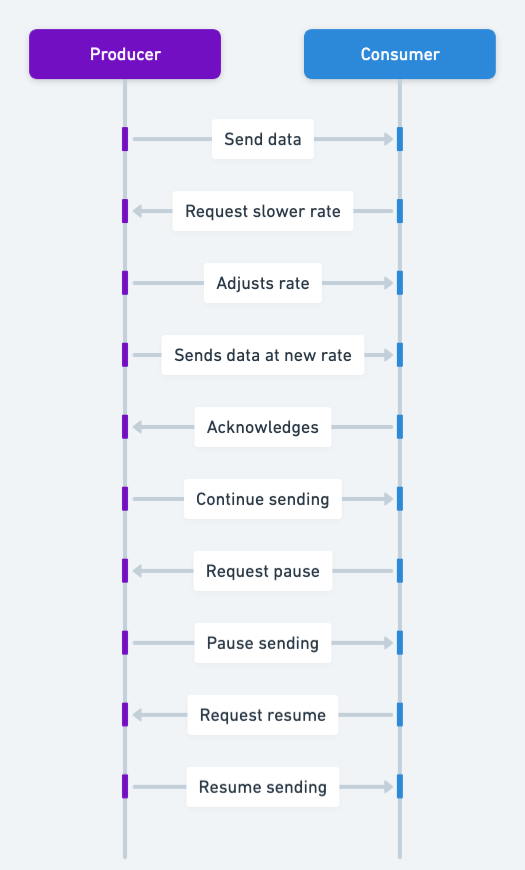
Programmatic Example of Backpressure Pattern in Java
This example demonstrates how backpressure can be implemented using Project Reactor. We begin by creating a simple publisher that emits a stream of integers, introducing a small delay to mimic a slower production rate:
public class Publisher {
    public static Flux<Integer> publish(int start, int count, int delay) {
        return Flux.range(start, count).delayElements(Duration.ofMillis(delay)).log();
    }
}
Next, we define a custom subscriber by extending Reactor’s BaseSubscriber. It simulates slow processing by sleeping for 500ms per item. Initially, the subscriber requests ten items; for every five items processed, it requests five more:
public class Subscriber extends BaseSubscriber<Integer> {

    private static final Logger logger = LoggerFactory.getLogger(Subscriber.class);

    @Override
    protected void hookOnSubscribe(@NonNull Subscription subscription) {
        logger.info("subscribe()");
        request(10); //request 10 items initially
    }

    @Override
    protected void hookOnNext(@NonNull Integer value) {
        processItem();
        logger.info("process({})", value);
        if (value % 5 == 0) {
            // request for the next 5 items after processing first 5
            request(5);
        }
    }

    @Override
    protected void hookOnComplete() {
        //completed processing.
    }

    private void processItem() {
        try {
            Thread.sleep(500); // simulate slow processing
        } catch (InterruptedException e) {
            logger.error(e.getMessage(), e);
        }
    }
}
Finally, in the main method, we publish a range of integers and subscribe using the custom subscriber. A short sleep in the main thread allows the emission, backpressure requests, and processing to be fully observed:
public static void main(String[] args) throws InterruptedException {
    Subscriber sub = new Subscriber();
    Publisher.publish(1, 8, 200).subscribe(sub);
    Thread.sleep(5000); //wait for execution

}
Below is an example of the program’s output. It shows the subscriber’s log entries, including when it requests more data and when each integer is processed:
23:09:55.746 [main] DEBUG reactor.util.Loggers -- Using Slf4j logging framework
23:09:55.762 [main] INFO reactor.Flux.ConcatMapNoPrefetch.1 -- onSubscribe(FluxConcatMapNoPrefetch.FluxConcatMapNoPrefetchSubscriber)
23:09:55.762 [main] INFO com.iluwatar.backpressure.Subscriber -- subscribe()
23:09:55.763 [main] INFO reactor.Flux.ConcatMapNoPrefetch.1 -- request(10)
23:09:55.969 [parallel-1] INFO reactor.Flux.ConcatMapNoPrefetch.1 -- onNext(1)
23:09:56.475 [parallel-1] INFO com.iluwatar.backpressure.Subscriber -- process(1)
23:09:56.680 [parallel-2] INFO reactor.Flux.ConcatMapNoPrefetch.1 -- onNext(2)
23:09:57.185 [parallel-2] INFO com.iluwatar.backpressure.Subscriber -- process(2)
23:09:57.389 [parallel-3] INFO reactor.Flux.ConcatMapNoPrefetch.1 -- onNext(3)
23:09:57.894 [parallel-3] INFO com.iluwatar.backpressure.Subscriber -- process(3)
23:09:58.099 [parallel-4] INFO reactor.Flux.ConcatMapNoPrefetch.1 -- onNext(4)
23:09:58.599 [parallel-4] INFO com.iluwatar.backpressure.Subscriber -- process(4)
23:09:58.805 [parallel-5] INFO reactor.Flux.ConcatMapNoPrefetch.1 -- onNext(5)
23:09:59.311 [parallel-5] INFO com.iluwatar.backpressure.Subscriber -- process(5)
23:09:59.311 [parallel-5] INFO reactor.Flux.ConcatMapNoPrefetch.1 -- request(5)
23:09:59.516 [parallel-6] INFO reactor.Flux.ConcatMapNoPrefetch.1 -- onNext(6)
23:10:00.018 [parallel-6] INFO com.iluwatar.backpressure.Subscriber -- process(6)
23:10:00.223 [parallel-7] INFO reactor.Flux.ConcatMapNoPrefetch.1 -- onNext(7)
23:10:00.729 [parallel-7] INFO com.iluwatar.backpressure.Subscriber -- process(7)
23:10:00.930 [parallel-8] INFO reactor.Flux.ConcatMapNoPrefetch.1 -- onNext(8)
23:10:01.436 [parallel-8] INFO com.iluwatar.backpressure.Subscriber -- process(8)
23:10:01.437 [parallel-8] INFO reactor.Flux.ConcatMapNoPrefetch.1 -- onComplete()
When to Use the Backpressure Pattern In Java
- Use in Java systems where data is produced at high velocity and consumers risk overload.
- Applicable in reactive or event-driven architectures to maintain stability under varying load conditions.
Benefits and Trade-offs of Backpressure Pattern
Benefits:
- Protects consumers from saturation and resource exhaustion.
Trade-offs:
- Introduces possible delays if production must slow down to match consumer capacity.
- Requires careful orchestration in complex systems with multiple concurrent data sources.
Related Java Design Patterns
- Observer Pattern: Both patterns involve a producer notifying consumers. Observer is synchronous and tightly coupled (observers know the subject).
- Publish-Subscribe Pattern: Both patterns deal with asynchronous data flow and can work together to manage message distribution and consumption effectively.