Intent
领域模型模式提供了一种面向对象的方式来处理复杂的逻辑。 不是有一个过程来处理用户操作的所有业务逻辑,而是有多个对象,每个对象都处理与其相关的领域逻辑片.
Explanation
Real world example
假设我们需要构建一个电子商务Web应用程序。在分析需求时,您会注意到有一些名词被反复提及。比如"客户","产品"。这两个是特定于域的类,每个类都将包含一些特定于其域的业务逻辑.
In plain words
域模型是结合了行为和数据的域的对象模型.
Programmatic Example
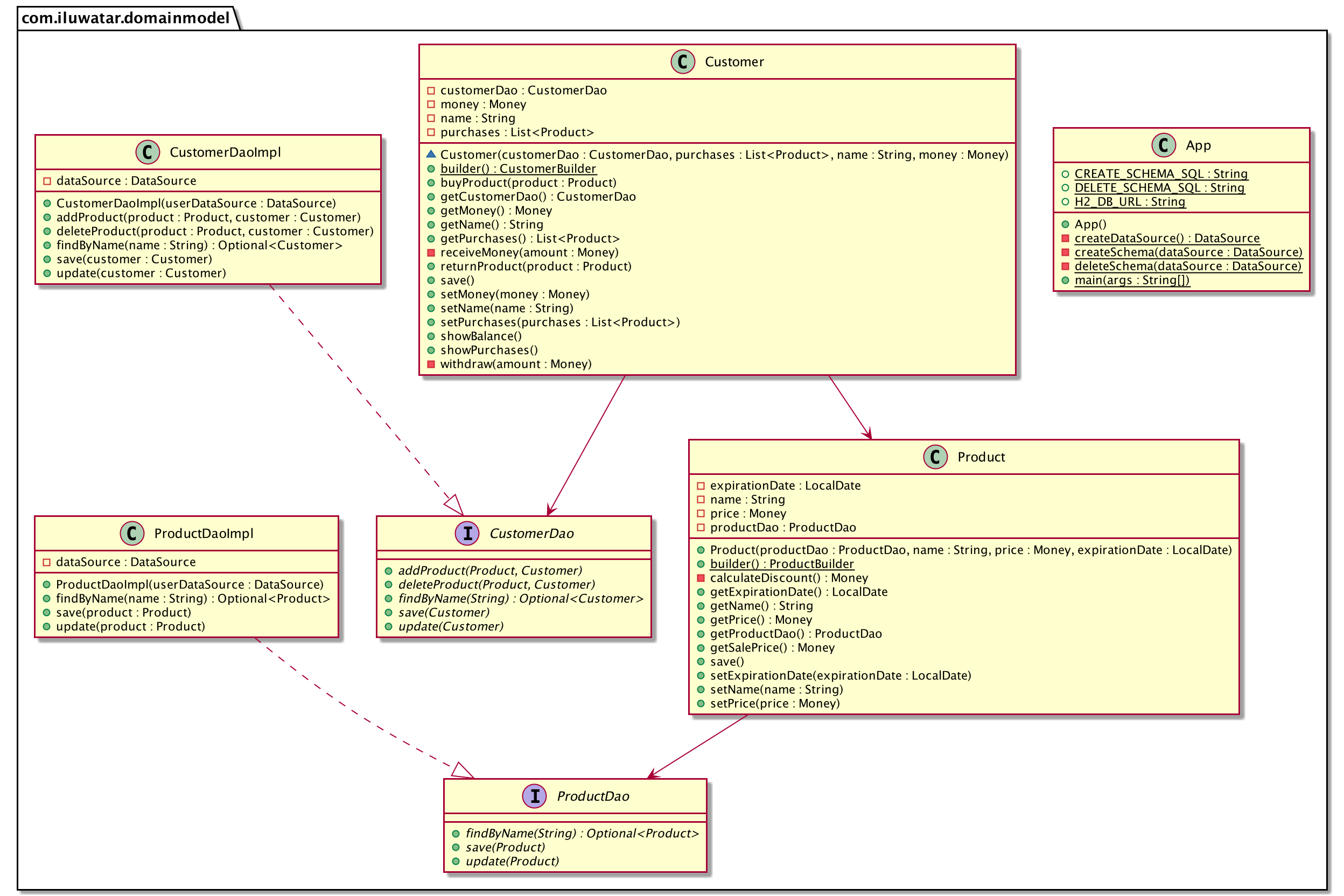
在电子商务应用程序的示例中,我们需要处理客户想要购买产品并退货的领域逻辑. We can use the domain model pattern and create classes Customer and Product where every single instance of that class incorporates both behavior and data and represents only one record in the underlying table.
Here is the Product domain class with fields name, price, expirationDate which is specific for each product, productDao for working with DB, save method for saving product and getSalePrice method which return price for this product with discount.
@Slf4j
@Getter
@Setter
@Builder
@AllArgsConstructor
public class Product {

    private static final int DAYS_UNTIL_EXPIRATION_WHEN_DISCOUNT_ACTIVE = 4;
    private static final double DISCOUNT_RATE = 0.2;

    @NonNull private final ProductDao productDao;
    @NonNull private String name;
    @NonNull private Money price;
    @NonNull private LocalDate expirationDate;

    /**
     * Save product or update if product already exist.
     */
    public void save() {
        try {
            Optional<Product> product = productDao.findByName(name);
            if (product.isPresent()) {
                productDao.update(this);
            } else {
                productDao.save(this);
            }
        } catch (SQLException ex) {
            LOGGER.error(ex.getMessage());
        }
    }

    /**
     * Calculate sale price of product with discount.
     */
    public Money getSalePrice() {
        return price.minus(calculateDiscount());
    }

    private Money calculateDiscount() {
        if (ChronoUnit.DAYS.between(LocalDate.now(), expirationDate)
                < DAYS_UNTIL_EXPIRATION_WHEN_DISCOUNT_ACTIVE) {

            return price.multipliedBy(DISCOUNT_RATE, RoundingMode.DOWN);
        }

        return Money.zero(USD);
    }
}
Here is the Customer domain class with fields name, money which is specific for each customer, customerDao for working with DB, save for saving customer, buyProduct which add a product to purchases and withdraw money, returnProduct which remove product from purchases and return money, showPurchases and showBalance methods for printing customer's purchases and money balance.
@Slf4j
@Getter
@Setter
@Builder
public class Customer {

    @NonNull private final CustomerDao customerDao;
    @Builder.Default private List<Product> purchases = new ArrayList<>();
    @NonNull private String name;
    @NonNull private Money money;

    /**
     * Save customer or update if customer already exist.
     */
    public void save() {
        try {
            Optional<Customer> customer = customerDao.findByName(name);
            if (customer.isPresent()) {
                customerDao.update(this);
            } else {
                customerDao.save(this);
            }
        } catch (SQLException ex) {
            LOGGER.error(ex.getMessage());
        }
    }

    /**
     * Add product to purchases, save to db and withdraw money.
     *
     * @param product to buy.
     */
    public void buyProduct(Product product) {
        LOGGER.info(
                String.format(
                        "%s want to buy %s($%.2f)...",
                        name, product.getName(), product.getSalePrice().getAmount()));
        try {
            withdraw(product.getSalePrice());
        } catch (IllegalArgumentException ex) {
            LOGGER.error(ex.getMessage());
            return;
        }
        try {
            customerDao.addProduct(product, this);
            purchases.add(product);
            LOGGER.info(String.format("%s bought %s!", name, product.getName()));
        } catch (SQLException exception) {
            receiveMoney(product.getSalePrice());
            LOGGER.error(exception.getMessage());
        }
    }

    /**
     * Remove product from purchases, delete from db and return money.
     *
     * @param product to return.
     */
    public void returnProduct(Product product) {
        LOGGER.info(
                String.format(
                        "%s want to return %s($%.2f)...",
                        name, product.getName(), product.getSalePrice().getAmount()));
        if (purchases.contains(product)) {
            try {
                customerDao.deleteProduct(product, this);
                purchases.remove(product);
                receiveMoney(product.getSalePrice());
                LOGGER.info(String.format("%s returned %s!", name, product.getName()));
            } catch (SQLException ex) {
                LOGGER.error(ex.getMessage());
            }
        } else {
            LOGGER.error(String.format("%s didn't buy %s...", name, product.getName()));
        }
    }

    /**
     * Print customer's purchases.
     */
    public void showPurchases() {
        Optional<String> purchasesToShow =
                purchases.stream()
                        .map(p -> p.getName() + " - $" + p.getSalePrice().getAmount())
                        .reduce((p1, p2) -> p1 + ", " + p2);

        if (purchasesToShow.isPresent()) {
            LOGGER.info(name + " bought: " + purchasesToShow.get());
        } else {
            LOGGER.info(name + " didn't bought anything");
        }
    }

    /**
     * Print customer's money balance.
     */
    public void showBalance() {
        LOGGER.info(name + " balance: " + money);
    }

    private void withdraw(Money amount) throws IllegalArgumentException {
        if (money.compareTo(amount) < 0) {
            throw new IllegalArgumentException("Not enough money!");
        }
        money = money.minus(amount);
    }

    private void receiveMoney(Money amount) {
        money = money.plus(amount);
    }
}
In the class App, we create a new instance of class Customer which represents customer Tom and handle data and actions of that customer and creating three products that Tom wants to buy.
// Create data source and create the customers, products and purchases tables
final var dataSource = createDataSource();
deleteSchema(dataSource);
createSchema(dataSource);

// create customer
var customerDao = new CustomerDaoImpl(dataSource);

var tom =
    Customer.builder()
        .name("Tom")
        .money(Money.of(USD, 30))
        .customerDao(customerDao)
        .build();

tom.save();

// create products
var productDao = new ProductDaoImpl(dataSource);

var eggs =
    Product.builder()
        .name("Eggs")
        .price(Money.of(USD, 10.0))
        .expirationDate(LocalDate.now().plusDays(7))
        .productDao(productDao)
        .build();

var butter =
    Product.builder()
        .name("Butter")
        .price(Money.of(USD, 20.00))
        .expirationDate(LocalDate.now().plusDays(9))
        .productDao(productDao)
        .build();

var cheese =
    Product.builder()
        .name("Cheese")
        .price(Money.of(USD, 25.0))
        .expirationDate(LocalDate.now().plusDays(2))
        .productDao(productDao)
        .build();

eggs.save();
butter.save();
cheese.save();

// show money balance of customer after each purchase
tom.showBalance();
tom.showPurchases();

// buy eggs
tom.buyProduct(eggs);
tom.showBalance();

// buy butter
tom.buyProduct(butter);
tom.showBalance();

// trying to buy cheese, but receive a refusal
// because he didn't have enough money
tom.buyProduct(cheese);
tom.showBalance();

// return butter and get money back
tom.returnProduct(butter);
tom.showBalance();

// Tom can buy cheese now because he has enough money
// and there is a discount on cheese because it expires in 2 days
tom.buyProduct(cheese);

tom.save();

// show money balance and purchases after shopping
tom.showBalance();
tom.showPurchases();
The program output:
17:52:28.690 [main] INFO com.iluwatar.domainmodel.Customer - Tom balance: USD 30.00
17:52:28.695 [main] INFO com.iluwatar.domainmodel.Customer - Tom didn't bought anything
17:52:28.699 [main] INFO com.iluwatar.domainmodel.Customer - Tom want to buy Eggs($10.00)...
17:52:28.705 [main] INFO com.iluwatar.domainmodel.Customer - Tom bought Eggs!
17:52:28.705 [main] INFO com.iluwatar.domainmodel.Customer - Tom balance: USD 20.00
17:52:28.705 [main] INFO com.iluwatar.domainmodel.Customer - Tom want to buy Butter($20.00)...
17:52:28.712 [main] INFO com.iluwatar.domainmodel.Customer - Tom bought Butter!
17:52:28.712 [main] INFO com.iluwatar.domainmodel.Customer - Tom balance: USD 0.00
17:52:28.712 [main] INFO com.iluwatar.domainmodel.Customer - Tom want to buy Cheese($20.00)...
17:52:28.712 [main] ERROR com.iluwatar.domainmodel.Customer - Not enough money!
17:52:28.712 [main] INFO com.iluwatar.domainmodel.Customer - Tom balance: USD 0.00
17:52:28.712 [main] INFO com.iluwatar.domainmodel.Customer - Tom want to return Butter($20.00)...
17:52:28.721 [main] INFO com.iluwatar.domainmodel.Customer - Tom returned Butter!
17:52:28.721 [main] INFO com.iluwatar.domainmodel.Customer - Tom balance: USD 20.00
17:52:28.721 [main] INFO com.iluwatar.domainmodel.Customer - Tom want to buy Cheese($20.00)...
17:52:28.726 [main] INFO com.iluwatar.domainmodel.Customer - Tom bought Cheese!
17:52:28.737 [main] INFO com.iluwatar.domainmodel.Customer - Tom balance: USD 0.00
17:52:28.738 [main] INFO com.iluwatar.domainmodel.Customer - Tom bought: Eggs - $10.00, Cheese - $20.00
Class diagram
Applicability
Use a Domain model pattern when your domain logic is complex and that complexity can rapidly grow because this pattern handles increasing complexity very well. Otherwise, it's a more complex solution for organizing domain logic, so shouldn't use Domain Model pattern for systems with simple domain logic, because the cost of understanding it and complexity of data source exceeds the benefit of this pattern.