目的
运用共享技术有效地支持大量细粒度的对象。
解释
现实生活例子
炼金术师商店的货架上摆满了魔法药水。许多药剂是相同的,因此不需要为每个药剂创建一个新对象,相反,一个对象实例可以表示多个货架上的物品,因此占用的内存空间很小。
通俗地讲
它通过与相似的对象尽可能多地共享内存以减少内存占用和提高性能。
维基百科上说
在计算机编程中,享元模式是一种软件设计模式。它使用物件用来尽可能减少内存使用量;与相似物件中分享尽可能多的数据。当大量物件近乎重复方式存在,使用大量内存时,此方法适用。
程序示例
编译我们上文中的炼金术师商店的例子。首先,我们有不同的药剂类型:
java
public interface Potion {
  void drink();
}

@Slf4j
public class HealingPotion implements Potion {
  @Override
  public void drink() {
    LOGGER.info("You feel healed. (Potion={})", System.identityHashCode(this));
  }
}

@Slf4j
public class HolyWaterPotion implements Potion {
  @Override
  public void drink() {
    LOGGER.info("You feel blessed. (Potion={})", System.identityHashCode(this));
  }
}

@Slf4j
public class InvisibilityPotion implements Potion {
  @Override
  public void drink() {
    LOGGER.info("You become invisible. (Potion={})", System.identityHashCode(this));
  }
}然后是实际的享元类PotionFactory,它是创建药水的工厂。
java
public class PotionFactory {

  private final Map<PotionType, Potion> potions;

  public PotionFactory() {
    potions = new EnumMap<>(PotionType.class);
  }

  Potion createPotion(PotionType type) {
    var potion = potions.get(type);
    if (potion == null) {
      switch (type) {
        case HEALING:
          potion = new HealingPotion();
          potions.put(type, potion);
          break;
        case HOLY_WATER:
          potion = new HolyWaterPotion();
          potions.put(type, potion);
          break;
        case INVISIBILITY:
          potion = new InvisibilityPotion();
          potions.put(type, potion);
          break;
        default:
          break;
      }
    }
    return potion;
  }
}炼金术商店有两个放魔法药水的货架。这些药水是通过前面提到的PotionFactory制造出来的。
java
@Slf4j
public class AlchemistShop {

  private final List<Potion> topShelf;
  private final List<Potion> bottomShelf;

  public AlchemistShop() {
    var factory = new PotionFactory();
    topShelf = List.of(
        factory.createPotion(PotionType.INVISIBILITY),
        factory.createPotion(PotionType.INVISIBILITY),
        factory.createPotion(PotionType.STRENGTH),
        factory.createPotion(PotionType.HEALING),
        factory.createPotion(PotionType.INVISIBILITY),
        factory.createPotion(PotionType.STRENGTH),
        factory.createPotion(PotionType.HEALING),
        factory.createPotion(PotionType.HEALING)
    );
    bottomShelf = List.of(
        factory.createPotion(PotionType.POISON),
        factory.createPotion(PotionType.POISON),
        factory.createPotion(PotionType.POISON),
        factory.createPotion(PotionType.HOLY_WATER),
        factory.createPotion(PotionType.HOLY_WATER)
    );
  }

  public final List<Potion> getTopShelf() {
    return List.copyOf(this.topShelf);
  }

  public final List<Potion> getBottomShelf() {
    return List.copyOf(this.bottomShelf);
  }

  public void drinkPotions() {
    LOGGER.info("Drinking top shelf potions\n");
    topShelf.forEach(Potion::drink);
    LOGGER.info("Drinking bottom shelf potions\n");
    bottomShelf.forEach(Potion::drink);
  }
}
在我们的情景中,一个勇敢的游客进入炼金术商店,喝下了所有的药水。
java
// create the alchemist shop with the potions
var alchemistShop = new AlchemistShop();
// a brave visitor enters the alchemist shop and drinks all the potions
alchemistShop.drinkPotions();
程序输出:
java
Drinking top shelf potions
You become invisible. (Potion=1509514333)
You become invisible. (Potion=1509514333)
You feel strong. (Potion=739498517)
You feel healed. (Potion=125130493)
You become invisible. (Potion=1509514333)
You feel strong. (Potion=739498517)
You feel healed. (Potion=125130493)
You feel healed. (Potion=125130493)
Drinking bottom shelf potions
Urgh! This is poisonous. (Potion=166239592)
Urgh! This is poisonous. (Potion=166239592)
Urgh! This is poisonous. (Potion=166239592)
You feel blessed. (Potion=991505714)
You feel blessed. (Potion=991505714)
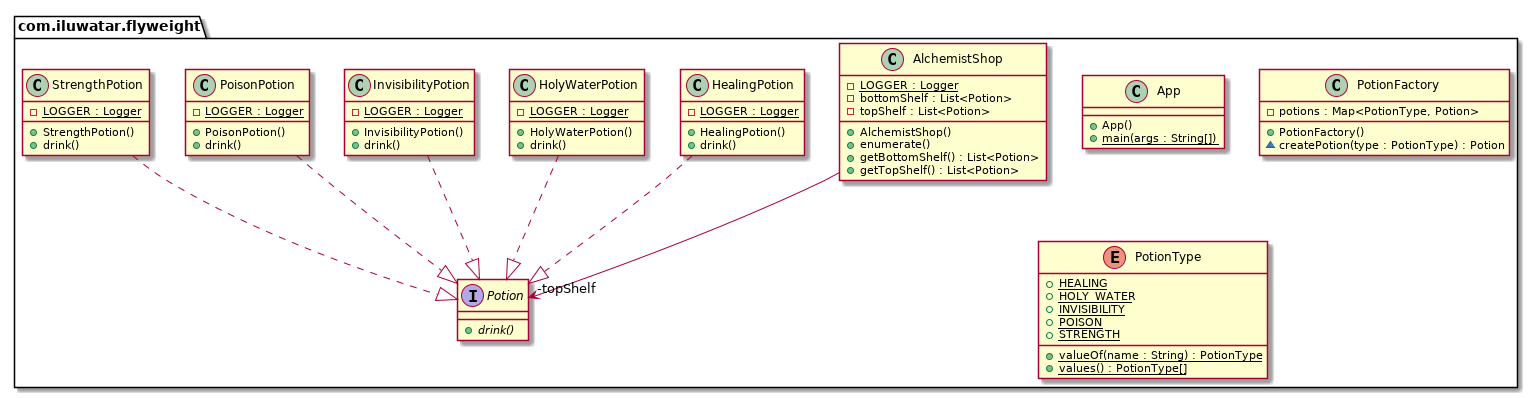
类图
适用性
享元模式的有效性很大程度上取决于怎么使用它和在哪里使用它。当以下所有条件都为成立时,应使用享元模式:
- 系统中有大量对象
- 这些对象消耗大量内存
- 这些对象的状态大部分可以外部化
- 这些对象可以按照内蕴状态分为很多组,当把外蕴对象从对象中剔除出来时,每一组对象都可以用一个对象来代替
- 系统不依赖于这些对象身份。因为享元对象可以共享,所以这些对象是不可分辨的
Java中例子
- java.lang.Integer#valueOf(int) ,Byte, Character 以及其他包装类型。